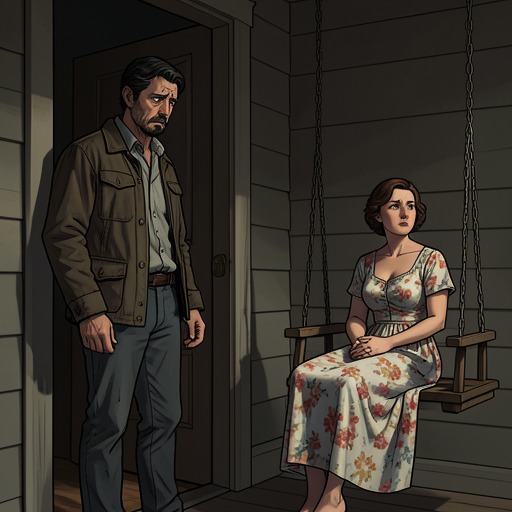
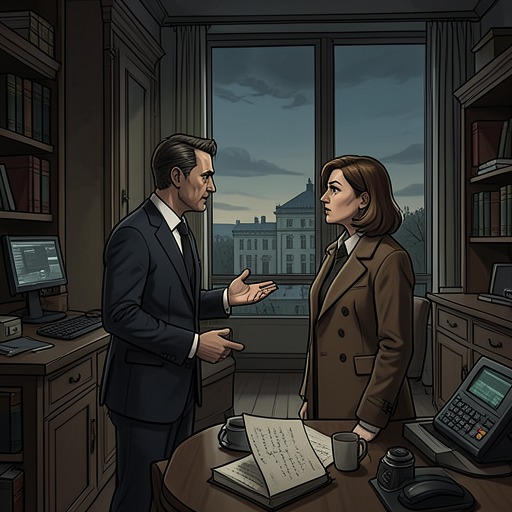
Rick Appeals to Vance for a Chance to Attend Atlas Brookings
Klara and the SunRick’s appeal to Mr Vance for a chance at Atlas Brookings becomes a double test: Rick must make the case for his abilities, while Miss Helen and Vance confront the old injury between them that shadows his application. The meeting offers Rick no immediate decision. Instead, its outcome is left suspended between Vance’s explicit refusal to overlook the painful past and Klara’s reading that his lingering affection for Helen may still move him to help.
The Request and Rick’s Case
Vance has been looking at Helen in silence when Rick begins by thanking him for giving up his time and even considering helping. When Vance invites him to explain, Rick describes his keen interest in drone technology and the system he has developed for his own team of drone birds. His ambition is not presented as a claim to be a prodigy. Faced with Vance’s question about whether his system surpasses everyone else’s work, Rick laughs nervously and clarifies that he is not claiming genius.
Instead, Rick emphasizes how he has worked: he developed the system himself, without tutors, using information he found online. His mother supported his efforts by ordering expensive books, and he has brought drawings so Vance can form a rough idea of what he is doing. Rick concedes that he is unlikely to achieve anything groundbreaking without expert guidance. That qualification makes the request both concrete and modest: he is asking for access to the instruction and opportunity he has not had, not insisting that his existing work already proves exceptional achievement.
The college is central because Rick and Helen understand Atlas Brookings as unusually open to capable students who have not benefited from genetic editing. Rick cautiously introduces the possibility that a liberal and generous institution might consider someone in his position. Vance confirms the importance of his own role: he chairs the college’s Founders’ Committee, the body that controls scholarships. The conversation therefore moves from Rick’s technical interests to the selection system that could determine whether those interests receive further development.
Merit, Favor, and the Turn in the Conversation
Vance describes a structural shortage rather than a simple route to admission. Atlas Brookings believes that talented young people have been denied the benefits of AGE for economic or other reasons and that society is making a grave mistake by failing to let those talents mature. But applications from such candidates greatly exceed the places the college can offer. Once the applicants deemed hopeless have been removed, Vance says, selection becomes a lottery. The principles of inclusion Rick hopes to invoke do not guarantee that he will be admitted.
Vance then asks why, if Rick is not seeking favoritism, Vance is sitting with him. The question abruptly changes the encounter. Helen, unlike Rick and Klara, seems to have anticipated it. She answers for her son and acknowledges plainly that they are asking Vance for a favor, one she believes he has the power to grant. She makes the appeal personal: she is asking him to give her boy a fighting chance. Rick tries to stop her, but Helen insists that making the request is her responsibility, not his.
Vance calls the tactic strange, observing that favoritism generally works best when it is not acknowledged. Yet his objection soon proves to be about more than the awkwardness of admitting what they want. He says that when he thought Rick was asking, the conversation was going well: Rick had impressed him, and Vance liked him. Helen’s intervention has changed the request into a favor from her, after years in which she did not answer Vance’s messages. Rick’s access to the college is now entangled with a history he did not create and cannot neatly separate from his mother’s appeal.
The Past Between Helen and Vance
Vance says the estrangement has lasted twenty-seven years. He denies harassing Helen’s mother, while conceding that he may initially have written with emotional intensity; by his account, he pleaded but did not threaten, blame, or harass. Helen agrees that he was persistent but that there was no unpleasantness of that sort. Vance’s correction matters in the scene: he wants Rick to hear the history accurately, even while Helen worries that the conversation is happening in front of her son.
The conflict turns on the meaning of Helen’s apology. She says she has become fragile and has lost her beauty not through age but through that fragility; she asks Vance to forgive her at least partially and to help Rick, while admitting that she has nothing to offer but pleading. Vance challenges the breadth of the apology and demands specifics. The exchange makes clear that her present request cannot undo the past by itself, and that Vance is unwilling to treat her distress as a substitute for naming what she did.
He recalls an evening at Miles Martin’s house when Helen told the others that he had not yet read the Jenkins Report, earning a laugh at his expense. Helen acknowledges that she was vindictive and apologizes. Vance also brings up a voicemail she left him in a hotel in Portland, Oregon. Helen calls the message despicable and describes how it returns to her in memory: she mentally replays leaving it, edits it into a less awful version, and then feels dreadful again. She says she did not know how to erase a message after leaving one. The apology is not a simple declaration of regret; it arrives as a repeated, painful act of recollection, while Rick watches his mother revisit an intimate history in which he has become the occasion but not the cause.
Departure and the Unsettled Outcome
When Helen vows that she will keep punishing herself until she has made amends, Rick intervenes. He tells Vance that he wants no assistance now and wants no part of what is happening. Helen rejects his withdrawal, insisting that he does not know what he is saying. Her effort to secure his future has become so entangled with the old relationship that Rick sees the cost of the appeal as unacceptable.
Vance rises and says he has to go. Helen asks him not to leave and reaches for the familiar detail of his fondness for donuts, but he agrees with Rick that the encounter is doing her no good. He tells Rick that he likes the drawings and likes him, urges him to take care, and says goodbye to Helen. He walks down the aisle and out through the glass door without looking back. There is no promise of a scholarship, no explicit offer to intervene, and no reconciliation between the former lovers. Rick and Helen remain together, looking down at the table; Rick tells Klara to join them in Vance’s vacated seat.
Afterward Helen asks what Vance will do and whether he is going to help, regretting that he did not give them a clear answer. Klara replies cautiously that she does not want to create unwarranted hope, but believes Vance will decide to help Rick because he is still fond of Helen. The judgment is explicitly Klara’s inference, not a decision confirmed by Vance. Rick, meanwhile, tells his mother that he will be fine without him. The scene ends with the practical question unresolved: it has revealed Vance’s regard for Rick and the depth of his unresolved attachment to Helen, but it has not established what he will do about Atlas Brookings.
Significance of the Encounter
The meeting places institutional merit and private obligation in direct tension. Rick’s self-directed work gives Vance something real to assess, while the college’s limited capacity means talent alone may not secure a place. Helen names the request as favoritism rather than disguising it as a neutral evaluation, but that honesty exposes the personal price attached to her appeal. Vance’s authority over scholarships gives their old intimacy present consequences: his decision, if he makes one, could shape Rick’s educational future.
The conversation also refuses a clean separation between parent and child. Helen insists that she must ask on Rick’s behalf, yet Rick ultimately rejects the help when the request becomes a painful negotiation over her past. Vance’s affection for the young man coexists with resentment toward his mother; his departure settles neither the application nor their relationship. Klara’s hopeful interpretation supplies a possible future beyond the scene, but its uncertainty preserves the distinction between emotional attachment and concrete assistance.